Monday, October 18, 2010
Been A While
I know it's been a while, but I finally made it back. It is hard to stay away. My reasons for coming back are as follow: I do have much to say, but I feel like nobody is willing to listen. I guess I have Marcella to thank for me coming back. After reading her blog I realized that writing can heal a hurt-soul just as well as anything else. I hope that I can come back more often and write.

Saturday, December 5, 2009
Last Post for ENGL 105
Due to technical difficulties, I could not copy and paste my last post for my English class onto this blog. However, here is the blog post on google docs.
Second Draft of Paper: "Life of H1N1 as a News Story"
Here is my second draft. I tried to revise the paper, but most of my changes were done by editing. I tried to make this draft read a little smoother by changing some of the wording.
Sunday, November 22, 2009
Monday, November 16, 2009
Taking an Approach
Harris says “taking an approach” is like reworking a piece. How can you rework a piece and maintain what the author was saying, while creating a new approach of your own. I think that without careful work, the process could be mislabeled as plagiarism. However, it goes on all the time, as Harris points out. “The cover song, in which one musician reinterprets a song associated with another, is a staple of rock and roll. And what you listen for in a good cover is not an imitation of the original, as in karaoke or American Idol, but a new rendering of it.”
News stories are very similar to the above example. Each writer reads an article, or several articles, in order to formulate the basis of his article. He takes what others have said into account, but the paper he writes is based more upon what he feels about the subject. Just like in music. The songwriter takes someone else’s words and expands or reworks them to formulate his own opinion.
This idea borders on the idea of plagiarism. Why? Well, you are taking other peoples’ work and creating your own piece out of it. But you do not cite your sources because you are not copying from them. You simply take what they have to say, and rework it in order to take some approach of you own. Though, this occurs all the time in the real world, I still feel like the idea of taking an approach should be further investigated by a writer in order to be fair and genuine in their work.
Wednesday, November 11, 2009
In Revision of "I Contradict To Contradict"
Though I do agree with my previous statement that you should not contradict a work unless there is some underlying purpose, I would, however, choose to “re-present” the term “contradict.” When in fact the post should have been about countering, I used the wrong terminology. Though, I do still hold that “the effectiveness of a contradiction should not be based on how well argued the ideas are, but rather of why they are being argued in the first place.”
Rather I wish to point out that in using the term “contradict,” I have in fact biased what Harris was saying. Harris would likely use the idea of contradicting in a different way than countering, whereas I was using the two interchangeably. Contradicting is the act of arguing against what someone is saying to the fullest. However, countering is more centered on the idea of taking what you are reading or thinking about, and forwarding it. The idea of “yes, but…” is more of what Harris is saying.
Though I did not realize it at the time, the words are terribly different when looked at again. Thus I have begun to realize the true value of word choice. We need to be careful in what words we choose to represent what we are trying to say. Even as I write this, I am consciously considering each word that is making up this blog post. Without effective word choice, the ideas you are trying to express can be hampered by the readers misunderstanding of the words you use.
Therefore, I have hopefully learned to consider whether I have picked the correct word or not. Granted, you can never truly know if your point is coming across the way you wish it, you should at least try to be correct in your word choice in order to do your point justice.
Saturday, November 7, 2009
I Contradict To Contradict
If you are contradictory for the sake of being contradictory, then you need to stop contradicting. You need to produce something from your contradiction in order to make a necessary contradictory statement. Why?
It is quite easy to contradict a piece for the sake of showing the faults of that piece. But, when Harris quotes his professor, we see a new idea. The idea that it does not matter what the writer did wrong because you have chosen a piece that is easily contradicted and for no great purpose. This idea of contradicting for a purpose is exactly what Harris discusses in this chapter.
So, we know what Harris’s statement is, but why would he say this? The effectiveness of a contradiction should not be based on how well argued the ideas are, but rather of why they are being argued in the first place. Harris believes that in order to effectively contradict someone there must be some purpose that would help society. The kind of purpose can be argued, but the main idea is that you almost further a piece if you successfully contradict it. If you can bring up old topics, or put a new spin on them by your arguing, then I believe Harris would likely say that you effectively contradicted for some purpose.
In all of Harris’s statements and opinions, he pushes for the idea of “re-presenting.” Therefore, Harris, himself, uses contradictions in order to further his own writing. So, the next time you read a Hedges article, don’t immediately respond to it. Think about how what you write could further what you have read, not only your own piece.
Wednesday, November 4, 2009
Rewriting as in Forwarding
Forwarding has many definitions. According to dictionary.com, the word “forward” has eighteen alternate definitions. However, all of the definitions have a similar meaning. Forward is an act of going further than that of the before. According to Harris, though forwarding is the idea of taking an existing conversation (i.e. paper, discussion, or anything of literary value) and furthering that conversation.
Even images or videos can spur a response. Harris is really saying that in order to forward a discussion, you have to add to that discussion. The hardest task, I think, would be if you were given a dead argument to bring back to life. That is what Harris is saying here. You need to bring an argument, in whatever form, back from the graveyard of literature. For example: The article you are being given is on the idea of the plague being a worldly epidemic in the 21st century. Well, obviously, this is a dead subject. But, if you could draw from the past some shred of evidence that says swine flu is the new black death of the time, then you could successfully bring back a dead subject.
But, after all, what would it matter? Well, Harris goes at the basis of how we should forward a work. His process includes “illustrating, authorizing, borrowing, and extending.” As we continue to read through all these processes, we are geared toward the fact that what we are doing, or trying to do, with the forwarding of a piece is to make it better. Every piece of literature has some meaning to some particular people in society. In order to make that piece of literature continue to have a meaning, we “re-present,” as Harris calls it, the material in a new way. So, we do this because we don’t want a subject to die. We don’t want to wake up one day and realize that what we love to read about is not a news story anymore and therefore has been deemed unnecessary for viewing. So, Harris’s “Forwarding” chapter helps us to see how discussions are forwarded, and the chapter leads us to believe that without this idea of forwarding, that the world of literature as we know it could cease to exist.
So, “the next time you write an essay in which you discuss a nonprint text, try to find a way to incorporate that text as seamlessly as you can into your document.” And revisit the old in order that you may further the conversation with your paper.
Saturday, October 31, 2009
Interesting Relationships and Terrible Drawings
When you start to think about all the differences and similarities among The New York Times and blogs, you find that The New York Times tries to expand upon the news of a second ago. However, blogs such as Big Government and The Daily Dish are always trying to update the news with a bias. The writers of these blogs are always rewording the news in order that their readers can relate to what they are reading. People like to know the facts of the second when they go to the Ney York Times.
After you have sufficiently read the news, you will undoubtedly be drawn to certain articles. Maybe, you even care enough to do more research on your own. Thus you would turn to a blog. Say you are following the political implications surrounding ACORN. Would you not wish to read from the site in which ACORN is a constant topic? Of course you would; it would be understandable that you would go to Big Government.
But how do all of these things relate to the “press sphere?” Well, when you start to realize that you are drawn to certain issues, certain articles of the day, then you begin to see that you are the controller of the “press sphere.” Whereas, in the past, the ecology of news in relation to you was more readily viewed as a funnel in which you get everything poured through the funnel for you,
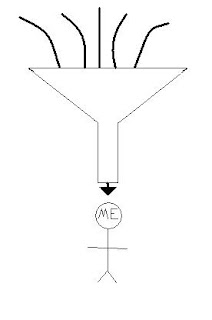
now, you can decide what comes out of the funnel because you are engineering what is going into it. Have fun with that.
After you have sufficiently read the news, you will undoubtedly be drawn to certain articles. Maybe, you even care enough to do more research on your own. Thus you would turn to a blog. Say you are following the political implications surrounding ACORN. Would you not wish to read from the site in which ACORN is a constant topic? Of course you would; it would be understandable that you would go to Big Government.
But how do all of these things relate to the “press sphere?” Well, when you start to realize that you are drawn to certain issues, certain articles of the day, then you begin to see that you are the controller of the “press sphere.” Whereas, in the past, the ecology of news in relation to you was more readily viewed as a funnel in which you get everything poured through the funnel for you,
now, you can decide what comes out of the funnel because you are engineering what is going into it. Have fun with that.
Thursday, October 29, 2009
Sullivan The Builder
While Jeff Jarvis blabbers on about the facts of how news has changed, we are not given any type of opinion explaining whether Jarvis believes that this has helped us or not. No, rather we are just threatened by oversimplified charts that show that the world has changed from the old way of news gathering (directly from the press to us), and has evolved into a system of overlaps enclosing the “me-sphere” as Jarvis calls it.
But, did we not already know this? Of course. We have been reading similar issues for the past few months. So, I get to Sullivan. In what Jarvis lacked in sophistication, Sullivan made up for in opinion. Jarvis tries not to take any role in whether he agrees or disagrees with what has happened. Sullivan, on the other hand shows his views from the start. As I have said in class, I believe it would have been easier to write about Jarvis’s blog if he would have expressed some opinion.
So, what is Sullivan’s opinion, and why does it matter? Well, as we all know Sullivan thinks that the shift from the old ways of reporting, and news gathering to the new are a good thing. He even defends his view with: “To the charges of inaccuracy and unprofessionalism, bloggers could point to the fierce, immediate scrutiny of their readers” (Why I Blog). For those who would say that this shift toward the more internet based news makes the news that Americans see, unedited and unkempt, Sullivan would disagree. He says that the more internet based we have become, has helped the ways in which we can view the kinds of news we want. Therefore, is it not enough to say that, though Jarvis told of the change, Sullivan enlightened the community of what exactly was inferred?
Tuesday, October 27, 2009
Press v. News
At first I thought, “But, are not the press and news the same? Are they mutually exclusive?” At the beginning of Jeff Jarvis’s “The Press Becomes the Press Sphere,” I was wondering at what he would define press, and if that would be different from news. I would have to think that they are vastly similar, if not the same. However, through his writing, I see what he is trying to say…I think.
Jarvis is attempting to say that though what we used to think of as the press relationship in news is still there, we have opened into another world where news is now influenced upon us through the uses of our peers. Now, we read what we believe to be news, but what, in all actuality, may not be related to the press at all. Our friend says to read something on some website, claiming it is news. We read it because we trust our friend, but what we read has no interrelationship with the press at all.
So, why is this bad? Well, if the press is not related to a specific “news” website, then such a website was not edited. But, what does that matter, you ask? Well, if a publication is not edited by a professional, there is no way of knowing if what you are reading is just some rogue opinion. You do not know if you should trust what you read. So, as Jeff Jarvis says, “if the news is important, it will find me.”
Friday, October 23, 2009
The News is no Better than the Tabloids
Is it the New York Times, or should it be called the new world stories? The New York Times has undoubtedly become a mainstay for the social intake of news in the world today, especially in the U.S. It is very easy to see that The NY Times has influenced many Americans in how they view the news.
Take this class for example. We are given to read The NY Times every day. Why? To make us more socially and politically active? Maybe. However, I cannot see where reading a news story about how a little boy supposedly was trapped in a flying saucer shaped balloon that could not have carried him in the first place has anything to do with the good of the people.
So, then, we ask ourselves why exactly we are being given such an unimportant subject to read. There is a simple solution. We are given such things to read because those are the kinds of things that we like to read. The newspaper would not make any money if it did not have advertising. Advertisers look for a popular news site that offers its viewers what they like to see. So, therefore we see the unimportant because we like to see the unimportant.
As I have said in past posts, newspapers are very similar to tabloids, in that you read the tabloids for a certain subject: gossip. Now, we have begun to read our newspapers with the same idea in mind. We want to read that which is entertaining.
So, how do I think I have changed? Well, I still view the newspaper as a factual subsidy for news, but now I also see it as another entertainment website, made for the pleasure of its viewers.
Thursday, October 22, 2009
Wait, You Don't Really Care, Do You?
Discourse, from the Latin discursus, is defined by Wikipedia as the written or spoken communication or debate. How then can we relate that to a discourse community. Simple: a discourse community is a group of people who discuss and debate on certain issues. In our class we have been focusing solely upon debate through news. But how can we be sure that the debates and communications are truthful? How can we trust the author who writes for our behalf, so that we may know the news of today?
One way is to take into consideration the amount of popularity the blog/news site has. Most of the time, but not all, the website’s popularity may be a good indication of how much viewers trust what they are reading. Of course, there are instances in which viewers are seeking out the bizarre and potentially untrue, like for instance in the tabloids. But, I believe it is safe to say that a viewer would not be inclined to trust a site if its main heading was that aliens landed on the planet or of what color underwear your favorite celebrity was wearing. Usually we would uphold the idea that celebrity news and world news are mutually exclusive.
So, what do we care? Well, we wonder at how accurate our news coverage is, and we wish it to be strictly facts. We even seek out the author’s background: prior work, knowledge about the field of study, and the like. However, we seek out the controversial headlines. Each of us is drawn towards the upsetting. An example is an article in Big Government entitled, “Rush or Reverend Al?...Will the Real Racist Please Stand Up?” I was drawn toward reading this article. Why? Because the title hinted at a very controversial subject, controversial and thereby entertaining.
Thus, I wonder if it really does matter that a news source be truthful. Would we care if the author of a tabloid had gone to prison for four years, or would that just add to the effect? Yet, we couldn’t stand the idea that a reporter for a strictly news source had even thought about putting his beliefs into a news story. Why?
Monday, October 19, 2009
Blogs I Shall Read
Well, I guess I have decided on Andrew Sullivan's blog and Big Government. I found that both of these suit my conservative views, while still giving me the news. I hope that each will help me to become better informed.
Jaded News
Desperately I yearned to hear that I was not alone. Could it be true that others, too, don’t watch the news as much as I? Haven’t we all heard that only the uncultured do not watch the news? Frankly, I do not in the least believe that garbage. How can we say we are cultured just because we read/watch the news? We cannot.
No, actually, I feel like the news has become almost an inconvenience to us. After reading some of the blogs in the class, it has registered in my mind that each of us receives news, but also that we each have a unique way to attain the news, apart from everyone else. Some people are quick to go to their favorite website. Some hear about the news when it is not new, but rather from word of mouth. Some read the newspaper. And some watch the news on their TV. However, no matter how much we try to get the news just as it is happening, we can never fully see it happening. Actually, no matter where we get our news, that news has been broadcasted and therefore has the potentiality to be jaded. If you read your article from the internet, someone with a brain and opinions wrote it. If you watch the news on TV someone has told you about the news through their point of view.
Am I saying that it is all a conspiracy, and that the FCC is controlling our minds to see what they want us to see? No. But, what I am saying is that we all are in a desperate search for the true news, but, in reality, we may never find it.
Saturday, October 17, 2009
Who News?
Mostly, it would be safe to say, I don’t know what is going on. Usually, I do not bother myself with the “news” of the world. What is the world, but a rotating globe of depressing news? Well, perhaps it’s not that bad. After all, we all need to know what is going on in the world today. However, I have known people to seek out the news of today. That aspect of being informed has never really seemed important to me. If I wanted to be informed, I would just ask my Mom. She always has the kind of news I want to hear. Well, did you hear about so-and-so? He went to the hospital for this particular thing.
Now, I am not saying that I agree with gossip. Gossip is such an ugly word. I prefer to think about it as news. After all, how did news start in history? With the passing of thoughts and with the passing of stories. Now, we see news as being very factual, or, rather, we hope that our news be completely factual. However, my primitive means of news are very important to me. Without local news, how can we coexist with the people around us? Not to mention the fact that I know the local people. I hope, since now I am away at college, to still hear and know how each of my friends is doing.
Thus, I wonder as to how people can say that I cannot function in society, because I do not know the world’s news. I don’t need to know what is going on in the world, but I do need to know what is going on in my world. Thus, I do not have a definitive answer to the question of where I get my news, if you are considerring the world's news, but I get the important news of today from my mom.
Friday, October 2, 2009
Wednesday, September 30, 2009
Wall Blocks
The wall is white and dusty. Block. Block. Block. It has shade, light, texture. It stands, unchanged, for all its life. When people talk to it, like a gentlemen, it listens. Things hang upon it, and it does not mind, nor complain. Just as we see how it holds us up, we tear it down.
The gentlemen in their rare, and now rather antique cars, travel down to the market for their groceries. They chaffier their wives or their dogs in their old trucks; the woman rides in the back, the dog in the front passenger seat. Or if she gets lucky, the wife may get to ride underneath the old hound dog, spit slinging into her hair. But, it is not her fault. Don’t blame her. She has a mental problem. The husband loves her for what she is. She loves the husband like a brother. Day after day he drives her to the store so she can hang her head out the window, gaping at the same trees and fields, cows and birds.
Of course, you know, the husband is no bad man either. He lets his wife/sister have what she wants, and he only asks for a little. Companionship. The old man was a loner, a traveler with no home. But, he fell in love with her. Though, may it be odd or not, he does love her. He even lets her ride in the back of the pickup truck sometimes. She loves it. She loves him, but only for a short time. When they get to the grocery, she feels like they all look at her. All those walls are staring at her. Are they judging her?
The husband stares at the walls as they round each aisle. He is protecting her, so she feels a little better. Then he looks back at her, asking if they need any more toilet paper. Toilet paper. It is white. Pure. But, not as white and immense as those walls. She quivers. He gets an extra pack just in case.
They get home. He packs the groceries in. She goes directly to her room. He wonders at himself, at her, and at the spoiled milk in the refrigerator. He forgot the milk. Later that night he sits at the table, drinking his coffee, staring at the wall. White and immense, it holds the husband together. He leans on it. If he only knew that in the next room, his love was building her strength up. It would be tonight. She would attack.
At midnight, when all was quiet, and her husband slept calmly, she slipped out to look at that wall. It was asleep, so it seemed. So, she gathered her homemade dynamite. Shotgun shells add up with gunpowder, plus the television can teach anyone anything. She placed those sticks at its feet. Now was the time. She didn’t hear her husband come to the door. She lit the sticks and looked in awe as the boom echoed through the fields. And the cows and birds stirred in their sleep, but did not awake.
The husband, still trapped under the rubble of the giant wall, clung desperately to life. How could the wall kill him? He loved the wall for what it was. He saw it as an immense ocean of faith, the blocks that held him up. Just as we see how the wall holds us up, we tear it down.
Monday, September 28, 2009
The Literacy Revolution
Here is my English 105 paper. Please comment on what you like/dislike about it.
Subscribe to:
Posts (Atom)