Sunday, November 22, 2009

Monday, November 16, 2009
Taking an Approach
Harris says “taking an approach” is like reworking a piece. How can you rework a piece and maintain what the author was saying, while creating a new approach of your own. I think that without careful work, the process could be mislabeled as plagiarism. However, it goes on all the time, as Harris points out. “The cover song, in which one musician reinterprets a song associated with another, is a staple of rock and roll. And what you listen for in a good cover is not an imitation of the original, as in karaoke or American Idol, but a new rendering of it.”
News stories are very similar to the above example. Each writer reads an article, or several articles, in order to formulate the basis of his article. He takes what others have said into account, but the paper he writes is based more upon what he feels about the subject. Just like in music. The songwriter takes someone else’s words and expands or reworks them to formulate his own opinion.
This idea borders on the idea of plagiarism. Why? Well, you are taking other peoples’ work and creating your own piece out of it. But you do not cite your sources because you are not copying from them. You simply take what they have to say, and rework it in order to take some approach of you own. Though, this occurs all the time in the real world, I still feel like the idea of taking an approach should be further investigated by a writer in order to be fair and genuine in their work.
Wednesday, November 11, 2009
In Revision of "I Contradict To Contradict"
Though I do agree with my previous statement that you should not contradict a work unless there is some underlying purpose, I would, however, choose to “re-present” the term “contradict.” When in fact the post should have been about countering, I used the wrong terminology. Though, I do still hold that “the effectiveness of a contradiction should not be based on how well argued the ideas are, but rather of why they are being argued in the first place.”
Rather I wish to point out that in using the term “contradict,” I have in fact biased what Harris was saying. Harris would likely use the idea of contradicting in a different way than countering, whereas I was using the two interchangeably. Contradicting is the act of arguing against what someone is saying to the fullest. However, countering is more centered on the idea of taking what you are reading or thinking about, and forwarding it. The idea of “yes, but…” is more of what Harris is saying.
Though I did not realize it at the time, the words are terribly different when looked at again. Thus I have begun to realize the true value of word choice. We need to be careful in what words we choose to represent what we are trying to say. Even as I write this, I am consciously considering each word that is making up this blog post. Without effective word choice, the ideas you are trying to express can be hampered by the readers misunderstanding of the words you use.
Therefore, I have hopefully learned to consider whether I have picked the correct word or not. Granted, you can never truly know if your point is coming across the way you wish it, you should at least try to be correct in your word choice in order to do your point justice.
Saturday, November 7, 2009
I Contradict To Contradict
If you are contradictory for the sake of being contradictory, then you need to stop contradicting. You need to produce something from your contradiction in order to make a necessary contradictory statement. Why?
It is quite easy to contradict a piece for the sake of showing the faults of that piece. But, when Harris quotes his professor, we see a new idea. The idea that it does not matter what the writer did wrong because you have chosen a piece that is easily contradicted and for no great purpose. This idea of contradicting for a purpose is exactly what Harris discusses in this chapter.
So, we know what Harris’s statement is, but why would he say this? The effectiveness of a contradiction should not be based on how well argued the ideas are, but rather of why they are being argued in the first place. Harris believes that in order to effectively contradict someone there must be some purpose that would help society. The kind of purpose can be argued, but the main idea is that you almost further a piece if you successfully contradict it. If you can bring up old topics, or put a new spin on them by your arguing, then I believe Harris would likely say that you effectively contradicted for some purpose.
In all of Harris’s statements and opinions, he pushes for the idea of “re-presenting.” Therefore, Harris, himself, uses contradictions in order to further his own writing. So, the next time you read a Hedges article, don’t immediately respond to it. Think about how what you write could further what you have read, not only your own piece.
Wednesday, November 4, 2009
Rewriting as in Forwarding
Forwarding has many definitions. According to dictionary.com, the word “forward” has eighteen alternate definitions. However, all of the definitions have a similar meaning. Forward is an act of going further than that of the before. According to Harris, though forwarding is the idea of taking an existing conversation (i.e. paper, discussion, or anything of literary value) and furthering that conversation.
Even images or videos can spur a response. Harris is really saying that in order to forward a discussion, you have to add to that discussion. The hardest task, I think, would be if you were given a dead argument to bring back to life. That is what Harris is saying here. You need to bring an argument, in whatever form, back from the graveyard of literature. For example: The article you are being given is on the idea of the plague being a worldly epidemic in the 21st century. Well, obviously, this is a dead subject. But, if you could draw from the past some shred of evidence that says swine flu is the new black death of the time, then you could successfully bring back a dead subject.
But, after all, what would it matter? Well, Harris goes at the basis of how we should forward a work. His process includes “illustrating, authorizing, borrowing, and extending.” As we continue to read through all these processes, we are geared toward the fact that what we are doing, or trying to do, with the forwarding of a piece is to make it better. Every piece of literature has some meaning to some particular people in society. In order to make that piece of literature continue to have a meaning, we “re-present,” as Harris calls it, the material in a new way. So, we do this because we don’t want a subject to die. We don’t want to wake up one day and realize that what we love to read about is not a news story anymore and therefore has been deemed unnecessary for viewing. So, Harris’s “Forwarding” chapter helps us to see how discussions are forwarded, and the chapter leads us to believe that without this idea of forwarding, that the world of literature as we know it could cease to exist.
So, “the next time you write an essay in which you discuss a nonprint text, try to find a way to incorporate that text as seamlessly as you can into your document.” And revisit the old in order that you may further the conversation with your paper.
Saturday, October 31, 2009
Interesting Relationships and Terrible Drawings
When you start to think about all the differences and similarities among The New York Times and blogs, you find that The New York Times tries to expand upon the news of a second ago. However, blogs such as Big Government and The Daily Dish are always trying to update the news with a bias. The writers of these blogs are always rewording the news in order that their readers can relate to what they are reading. People like to know the facts of the second when they go to the Ney York Times.
After you have sufficiently read the news, you will undoubtedly be drawn to certain articles. Maybe, you even care enough to do more research on your own. Thus you would turn to a blog. Say you are following the political implications surrounding ACORN. Would you not wish to read from the site in which ACORN is a constant topic? Of course you would; it would be understandable that you would go to Big Government.
But how do all of these things relate to the “press sphere?” Well, when you start to realize that you are drawn to certain issues, certain articles of the day, then you begin to see that you are the controller of the “press sphere.” Whereas, in the past, the ecology of news in relation to you was more readily viewed as a funnel in which you get everything poured through the funnel for you,
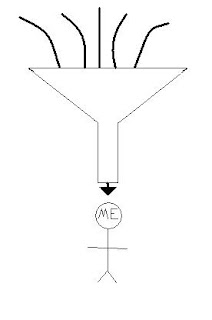
now, you can decide what comes out of the funnel because you are engineering what is going into it. Have fun with that.
After you have sufficiently read the news, you will undoubtedly be drawn to certain articles. Maybe, you even care enough to do more research on your own. Thus you would turn to a blog. Say you are following the political implications surrounding ACORN. Would you not wish to read from the site in which ACORN is a constant topic? Of course you would; it would be understandable that you would go to Big Government.
But how do all of these things relate to the “press sphere?” Well, when you start to realize that you are drawn to certain issues, certain articles of the day, then you begin to see that you are the controller of the “press sphere.” Whereas, in the past, the ecology of news in relation to you was more readily viewed as a funnel in which you get everything poured through the funnel for you,
now, you can decide what comes out of the funnel because you are engineering what is going into it. Have fun with that.
Thursday, October 29, 2009
Sullivan The Builder
While Jeff Jarvis blabbers on about the facts of how news has changed, we are not given any type of opinion explaining whether Jarvis believes that this has helped us or not. No, rather we are just threatened by oversimplified charts that show that the world has changed from the old way of news gathering (directly from the press to us), and has evolved into a system of overlaps enclosing the “me-sphere” as Jarvis calls it.
But, did we not already know this? Of course. We have been reading similar issues for the past few months. So, I get to Sullivan. In what Jarvis lacked in sophistication, Sullivan made up for in opinion. Jarvis tries not to take any role in whether he agrees or disagrees with what has happened. Sullivan, on the other hand shows his views from the start. As I have said in class, I believe it would have been easier to write about Jarvis’s blog if he would have expressed some opinion.
So, what is Sullivan’s opinion, and why does it matter? Well, as we all know Sullivan thinks that the shift from the old ways of reporting, and news gathering to the new are a good thing. He even defends his view with: “To the charges of inaccuracy and unprofessionalism, bloggers could point to the fierce, immediate scrutiny of their readers” (Why I Blog). For those who would say that this shift toward the more internet based news makes the news that Americans see, unedited and unkempt, Sullivan would disagree. He says that the more internet based we have become, has helped the ways in which we can view the kinds of news we want. Therefore, is it not enough to say that, though Jarvis told of the change, Sullivan enlightened the community of what exactly was inferred?
Subscribe to:
Posts (Atom)